


Strike!!!
Britain is on strike. A massive strike to bring the government to its knees and force a general election.
At least, that’s the claim.
This isn’t just people refusing to work for a week. The strike also involves not shopping, not going to the pub, not doing… anything. Total withdrawal from society.
You didn’t notice? You’re not the only one. So far, participation appears to be somewhere around fifty people. Possibly fewer if you exclude the organisers themselves.
Because the so-called Great British Strike is neither a registered trade union nor an organisation conducting balloted industrial action under the statutory framework, anyone taking part would not enjoy the legal protections normally associated with lawful strikes. But that turns out not to matter very much, because most of the “strikers” don’t appear to have jobs in the first place.
A strike by people who don’t actually work is a fairly perfect metaphor for the online right.
Despite the microscopic turnout, the Great British Strike has managed to produce a full range of branded merchandise. Revolution, but make it dropshipping.
The Great British National Strike was organised by Richard Donaldson, an ex-soldier from Chester, who claimed the aim was to “unite” the country against the government through nationwide action. Although promoted as an “apolitical” event, it very quickly attracted backing from the usual mix of far-right activists, conspiracy theorists, and culture-war entrepreneurs.
It’s actually quite hard to work out what GBS is. The movement variously known as the Great British Strike or Great British National Strike is not a registered company, not a trade union, not a political party, and not a legally recognised entity of any kind. Searches of Companies House, trade union registers, and credible reporting turn up nothing. It exists almost entirely online, sustained by vibes, Facebook and the belief that posting counts as politics.
This wasn’t even its first attempt. A previous “national strike” last May attracted a small assortment of anti-migrant street activists, conspiracy theorists, hard-line fascists, and a Cornish parish councillor who claimed the Holocaust was “massively over-exaggerated”. Unity, of a sort.
Initially, GBS enjoyed encouragement from GB News, which breathlessly promised half a million strikers. That relationship appears to have soured, suggesting that even by the standards of the far-right media ecosystem, Donaldson may be difficult to work with.
Following the electoral successes of Reform UK, it’s hardly surprising that opportunists like Donaldson are trying to tap into the vein of populist anger running through British politics. But while that anger is easily roused online, translating it into real-world action remains a much harder task. Posting is easy. Organising is not.
Rupert’s Pretend Rape Gang Inquiry
While some corners of the online right are busy staging pretend strikes, others are transfixed by Rupert Lowe’s equally pretend “rape gang inquiry”.
Lowe’s much-trumpeted initiative has all the hallmarks of a political performance rather than a serious attempt at scrutiny. Announced with maximal rhetoric and minimal institutional backing, it sits awkwardly outside the established mechanisms that actually investigate crime, safeguarding failures, or prosecutorial decisions. There is no statutory power, no evidential threshold, and no clear methodology — just the familiar culture-war narrative: elites covered it up, truth was suppressed, now a lone truth-teller will expose everything.
That doesn’t mean there weren’t real and grave failures in how grooming gangs were handled. There plainly were. But turning those failures into a personal crusade substitutes outrage for analysis and noise for accountability. If the aim were justice or reform, the work would be slow, technical and largely invisible. The fact that this exercise is loud, personalised and brand-aligned should give anyone pause.
It is also worth noting that when Suella Braverman was Home Secretary, she refused to hold a national grooming gangs inquiry, declined to reopen investigations, and failed to implement the findings of previous reviews. At the time, the online right was conspicuously silent.
When a new government began doing precisely those things, the same voices erupted in fury.
It’s almost as if they were never especially concerned about grooming gangs at all — and were instead more interested in exploiting victims’ suffering as a vehicle for their own grievances.
Meanwhile, in the real world, police forces continue to make arrests — lots of them — of grooming gang members. Which is one reason coverage of Lowe’s publicity stunt is so poor: irresponsible commentary risks prejudicing future trials. That doesn’t seem to trouble Lowe. Attention appears to be the point.
UKIP, Somehow Still Alive
You might be surprised to learn that UKIP still exists. Most of its members and donors have migrated to Reform, but UKIP staggers on regardless.
This is its new logo.
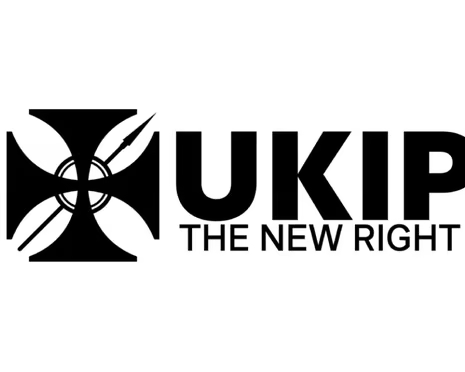
If it looks a bit… fascist, that’s not accidental.
UKIP retains close links to the American far right and its seemingly endless supply of money, particularly organisations such as Turning Point and the Heartland Institute.
The Heartland Institute recently hosted a dinner at Mark’s Club in Mayfair — an increasingly popular venue for the British far right’s social set. Guests reportedly included Nigel Farage, Liz Truss, Lois Perry of UKIP, and Mike Graham, famed for his views on concrete:
An Alphabet Soup of Grift
The result is an alphabet soup of overlapping projects all competing for the same audience: Reform, UKIP, Advance (run by former Reform treasurer Ben Habib), Restore Britain (fronted by Lowe), BRUV — Britain Restoring Underlying Values — led by Andrew Tate, and Reclaim, headed by Laurence Fox.
There are probably others.
All generously funded by British and American far-right billionaires. All competing with one another. And all perfectly willing to collaborate when the price is right.
The online right is noisy, performative and extremely well-financed. What it is not — despite its own hype — is particularly effective at doing anything in the real world.
The reason why Reform UK (né Brexit Party) even exists — and also the reason why it was established as a limited company that would keep Farage in total control — is because while Farage was off being a twat in Brussels, UKIP was hijacked by Christofascist fanatics bent on re-fighting the Crusades, that even Farage thought were nuts.
That’s also why the new UKIP logo has such strong Knights Templar vibes to it!