

We woke up 10 years ago to discover Britain had voted to leave the EU. For many a day of national humiliation.
I started writing Industrial Estate of Mind shortly after the Brexit vote.
At the time I was working just outside Durham in an area that had been solidly Labour for generations but had voted heavily to leave the European Union. What happened over the following decade tells a story not just about Brexit, but about what Brexit did to Britain.
The constituency’s long-serving Labour MP stood down, worn down by abuse and threats. She was replaced by a short-lived Corbynite MP who seemed determined to personally insult the voters she represented. Then came a Conservative MP who rose to become party chairman during the collapse of the Truss government before abandoning the constituency for a safer seat in southern England. Today the seat has returned to Labour, but last year Reform swept the council elections.
I suspect Darren Grimes already has his eye on the constituency.
I went back there yesterday on a hot sunny day, cycling slowly up the many big hills. The remarkable thing is not how much the political representation has changed. It is how much the mood has changed.

Anger
The most obvious impact of Brexit has been anger. Not disappointment. Not frustration. Anger.
I returned to Britain from Spain last year and was struck by how different the atmosphere felt. The country seemed permanently on edge. A trip to the supermarket could turn into an argument over a parking space. Driving anywhere felt like an invitation to road rage. The riots that erupted across parts of the country in 2024 were simply the most visible expression of a society that increasingly seems ready for a fight, even if it is not entirely sure who the enemy is.
Remain voters are angry because they believe Brexit has damaged the country.
Leave voters are often angrier still.
Different Leave campaigns promised more money for the NHS, lower immigration, economic renewal and national revival. Some promised the return of industries that had disappeared decades ago. Others suggested that Britain would regain a level of sovereignty it had never actually lost. The bloke round the corner believed profoundly that leaving the EU would bring about the second coming of Jesus, and had a massive sign made to tell us all the good news.
For many people the referendum felt like a victory. They had beaten politicians, experts, business leaders and journalists. They had finally got one over on people they disliked and distrusted.
Then reality arrived. Their towns remained poor. Public services got worse Immigration remained high. The promised renaissance never appeared.
Yet instead of blaming the politicians who made the promises, many directed their anger elsewhere. The establishment had betrayed them. Civil servants had sabotaged Brexit. Judges had interfered. Remainers had refused to accept the result.
The target changed regularly. The anger remained constant.
Take Back Control
The most powerful slogan of the referendum campaign was “Take Back Control”.
For many voters this meant control over borders, laws and immigration. But I increasingly suspect it meant something else as well.
I recognised part of the sentiment from my own childhood.
The area where I grew up was East Durham. It was politically left-wing but socially conservative. Men worked. Women stayed at home. Gay people kept quiet. Immigrants worked in takeaways if they existed at all. Difference was tolerated only if it remained invisible. The greatest social crime was getting ideas above your station.
People were expected to know their place.
Brexit was partly about restoring a sense of control over a changing country. But it was also about restoring older social hierarchies. It appealed to people who felt that the world had become too diverse, too cosmopolitan and too difficult to understand. The people who voted Brexit were anxious that their own place in a rigid social hierarchy was being eroded. The unlikely coalition of snobbish posh boys and anxious older voters were united by their fear that the social order of the country was changing to their detriment.
It was not simply an attempt to turn the clock back. It was an attempt to clip the wings of people who no longer knew their place.
That sentiment still runs through much of the politics of Reform UK and through many of the communities that have shifted from Labour to Brexit to Reform.
The Normalisation of Intimidation
The most tragic victim of Brexit-era politics was Jo Cox.
But political intimidation did not begin or end with her murder.
The referendum unleashed a level of hostility that British politics had not experienced for decades. MPs who questioned Brexit received torrents of abuse. Death threats became commonplace. Some MPs eventually left Parliament because the pressure on themselves and their families became unbearable.
During the referendum campaign I was asked to act as a business spokesperson for Remain in the North East. I declined after threats to boycott my business.
A few years later I was interviewed by BBC local news after Durham Distillery secured a new export customer. My comments were balanced. I discussed both the difficulties Brexit had created and the ways businesses were adapting.
The producer later told me they would edit the interview to make it appear more supportive of Brexit because they feared the reaction from Leave voters.
Afterwards they showed me some of the comments that had been received.
The one I remember was simple.
“Hang the fucking traitor.”
Cheating Works
One of the most important lessons of Brexit was that cheating works.
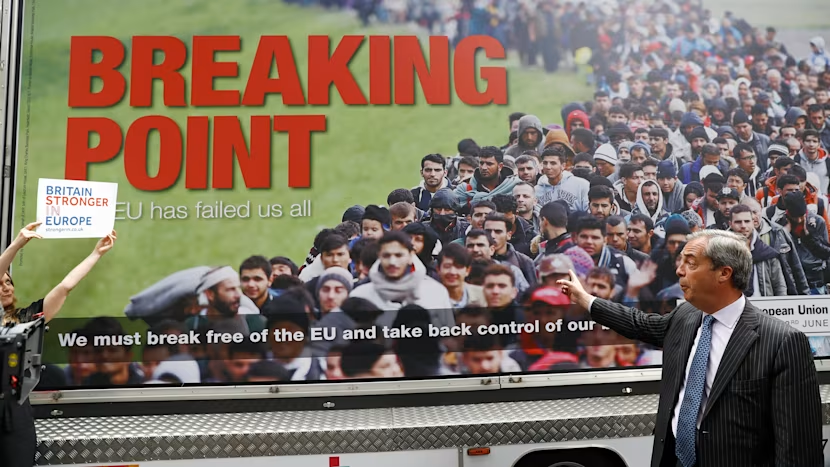
The referendum campaign saw multiple breaches of electoral law identified by the Electoral Commission. Vast sums were spent on highly targeted online advertising. Campaigners pushed misleading claims that could be tailored to tiny groups of voters.
Animal lovers received adverts about Spanish bullfighting.
Concerned voters received adverts about Turkish immigration.
Others received endless repetition of the infamous £350 million NHS claim.
The technology was new. The principle was not.
The purpose was to bypass rational debate and appeal directly to emotion.
What Brexit demonstrated was that there was little political cost to doing so.
Many voters knew politicians lied. Some admired them for it.
Putin Politics
The debate about Russian involvement in Brexit often misses the larger point.
Perhaps Russia influenced the referendum. Perhaps it did not influence it enough to change the result. Historians will argue about that for decades.

What matters is that Brexit marked the arrival of a style of politics that Vladimir Putin had already perfected.
Hannah Arendt once described authoritarian systems as places where “everything is possible and nothing is true”.
Social media has made that condition vastly easier to create.
Modern political campaigns do not need to persuade people that a particular claim is true. They merely need to persuade them that truth itself is unknowable.
If every institution lies, every expert is corrupt and every source of information is compromised, then politics becomes entirely emotional. People vote according to identity, grievance and resentment rather than evidence.
Brexit was the moment that style of politics entered the British mainstream.
A substantial section of the electorate no longer evaluates claims according to whether they are true.
The question is whether they feel true.
The Big Win
By most conventional measures Brexit has failed.
It has not produced faster economic growth.
It has not revived Britain’s former industrial regions.
It has not reduced immigration.
It has not generated the national renewal that voters were promised.
Yet Brexit has still been an extraordinary success.
Not for the country.
For the people who used it.
Boris Johnson became Prime Minister. Nigel Farage finally entered Parliament. A network of wealthy donors, campaigners and media personalities gained influence and power. The political centre was weakened. Trust in institutions declined. Public debate became more tribal and more emotional.
If the purpose of Brexit was to increase prosperity, it failed.
If the purpose of Brexit was to reduce immigration, it failed.
If the purpose of Brexit was to regenerate towns like the one I worked in, it failed.
But if the purpose of Brexit was to reshape British politics, create a permanent politics of grievance and open the door to a more authoritarian form of populism, then it succeeded beyond its architects’ wildest dreams.
Ten years on, that may be its most enduring legacy.
https://www.theguardian.com/politics/2026/jun/14/how-uk-economy-changed-since-brexit-vote-charts
https://www.csis.org/blogs/brexit-bits-bobs-and-blogs/did-russia-influence-brexit
https://www.bbc.co.uk/programmes/m002xhvj
“One of the most important lessons of Brexit was that cheating works.”
The main thing that structurally deters political parties from lying through their teeth in General Election campaigns is that if they win office on the basis of lies, they will then have to govern as though those lies were actually true, and (after they inevitably fail to do so) they will pay the price in the next General Election.
Referendums though eliminate this safeguard, because the campaigns that contest a referendum do not have any meaningful existence any more once the result is in.
Very true, and referendums amplify the power of social media
Great précis of a very complex turning point in British history. I first moved to the north east from South London in 1987 as a charge nurse and was struck by a very different culture from the one I grew up in. For the first time in my life people wanted to know whether I was a catholic given my Irish name and were openly racist in front of me. I’d never come across this level of hostility previously and made myself very unpopular in certain quarters when I challenged it. It began to dawn on me that the Brexit vote was long a few months before the vote. People would let me know that if it wasn’t for all those immigrants the NHS would be in a much better position and there would be such a long waiting list. Leaving the EU ergo meant more money and less immigrants using it. When I highlighted that flat line funding for several years with a growing elderly population was a root cause of waiting lists and that reducing nurses training was a significant factor was lost on them. Even when I mentioned that 20% of the workforce were immigrants it just made them angrier and that immigrants were generally younger and healthier and less likely to use health services – made them just walk away. The thing is this wasn’t just one random conversation – it happened time and time again. I was at a loss to understand where they were getting all this misinformation from. It was only sometime afterwards when I fully understood the Cambridge Analytica scandal did I appreciate the micro messaging that was going on in social media and in particular Facebook that I began to understand how it all came together. How we turn this round is another subject. But turn it around we surely must.
All sadly true. The big split in British politics isn’t between left and right, but between those who get their opinions from Facebook, and those who don’t
Except that Nigel described encountering sectarian hostility in the north east in 1987, which wasn’t just before Facebook came into existence, but also before the general public had access to the internet at all!
These sentiments existed in the north east before social media. In my blog I described growing up in east durham, in places which were very left wing, but incredibly social conformist, a rigid social hierarchy, with severe punishments for stepping out of line. There was also in some parts of the north east a tradition of working class toryism, which normally mapped onto particular industries (those who wouldn’t allow catholics, or any non-protestant to work there). Maybe I am naive, or maybe I just moved too far away, but it seemed as if this started to die out. Then social media came along and tapped into these traditions, but added to them all kinds of fear and paranoia about immigration, islam, trans, all kinds of stuff.
Yes very true. I remember in 2012 during the Olympics opening ceremony – I felt that as a nation we felt comfortable in our own skin. How wrong could I be…! Social media came along and the Boris Johnson started to normalise anti EU and anti immigrant and anti Islam sentiment in his newspaper columns over a number of years.
Me too, I worked on 2012 before games time and I went to a few of the events, including USA vs Iran wrestling! We were a nation then that was comfortable with diversity and who we were. Clearly there were a lot of people who felt excluded from that, and whose jealousy and anger was directed towards the rest of us who were. But we are still the majority
This is the great paradox. Every opinion poll and survey tells us that we are less and less racist, more comfortable with diversity, and yet my non-white friends and families experience of racism hasn’t really changed. We have a shrinking minority of racists being amplified by politicians and social media.
Brexit is the proof of how much political capital you can get from exploiting the anger and grievances of a powerful minority
I think theres an element to society that feels like they’ve been silenced by the PC drive in 90’s, 00’s and much of 10’s, people that have bit their tongue. Brexit, Farage and like minds on social media have unleashed them again, a return to the good old days where you could you could gays ‘bum chums’ and blame your woes on brown people, without being called racist or homophobic – finally they are being given a license to punch down.
People have blamed woke, political correctness, right-on politics for decades. I always thought it was about changing workplaces. If you work in an all male shift in a coal mine a mile underground you can say what you like. If you work in a company that is customer facing (even if you are not customer facing yourself) your employer will have some strict rules about how you behave and how you treat customers and fellow workers. This will include respecting peoples race, gender, sexuality, etc. This is a big shock for people who grew up in a world where men worked, a woman’s place was in the kitchen, LGBT place was in the closet.
Added to that the rise of HR – the UK now has more HR managers that Doctors, and the expansion of a diverse professional and managerial class who act as the go-betweens/human shields between ever more remote bosses and their workers